As a parent, nothing matters more than safety when you’re choosing something your baby will grip, mouth, and inevitably drop on the floor.
A wooden baby rattle can be a great choice because it’s simple and sturdy, and many wooden baby rattles feel calmer than loud plastic toys.
1. Why Parents Choose a Wooden Baby Rattle
1.1 The real reasons people choose “wooden”
Many families prefer wooden rattles because they feel natural, quiet, durable, and calm in a home that’s already noisy.
A well-made Wooden Rattle also tends to avoid the “too many parts” problem that shows up in some cheaper toys.
Wood is not automatically better, but it often pushes brands toward simpler designs.
Simple designs matter because a baby rattle becomes a chewing object fast.
1.2 What a good rattle should do at each stage
A great baby rattle does one job well: it helps your baby practice grip, shake, listen, and repeat, which builds early coordination.
A simple baby rattle toy often beats a complicated gadget because babies learn by repeating the same action a hundred times.
At first, it’s “I can hold,” then “I can control,” then “I can explore with my mouth.”
That’s why the best rattle toy changes by age even if the toy looks similar.
2. Are wooden rattles safe for babies?
Wooden Baby Rattle structure
Let’s answer it directly: Are wooden rattles safe for babies?
They can be, but the real safety feature is construction, not wood.
Safer wooden baby rattles usually have:
- No small detachable pieces that could become a choking hazard.
- No weak joints that loosen after drops or chewing.
- No rough edges that can turn into splinters, cracks, or sharp seams.
If you’re choosing between “prettier” and “simpler,” pick simpler.
The safest Wooden Rattle is often the one that looks almost boring: rounded, solid, and hard to break.
Here’s the fast real-life check that matters:
- Pull test: tug anything that looks like a join or connector.
- Shake test: listen for weird clacking that hints something is loose inside.
- Edge test: run your fingertip around every curve and groove.
- Gap test: check for pinchy gaps that could trap a finger.
If anything moves, scratches, or feels questionable, it’s a no.
Coating concerns
Coating is where parents hesitate, and that hesitation is valid.
Unfinished wood can feel harder to sanitize, while coated wood can raise worries about chipping when a baby chews.
The practical approach is to choose toys that are clear about materials and finish, and avoid listings that sound confident but stay vague.
If a brand won’t clearly explain what the finish is and that it’s intended for infant mouthing, skip it.
Why DIY is not recommended at home
A homemade rattle sounds wholesome until you remember how babies use toys.
They chew hard, throw often, and stress every joint until it fails.
DIY also makes it hard to confirm long-term durability and finish safety for an item that becomes a daily mouthing tool.
If you want a safer “handmade vibe,” choose a simple, infant-rated product and keep your DIY energy for nursery decor.
2.2 When a wooden rattle is not recommended
There are times when the safest move is to pass.
Avoid wooden rattles if they’re:
- Secondhand or vintage with unknown finish history.
- Missing clear age guidance.
- Showing any crack, looseness, roughness, fuzzing, or flaking.
Some marketplace listings even file these toys under awkward tags like wood baby, but categories don’t protect a baby’s mouth.
When in doubt, replace the toy instead of trying to “fix” it.
4. What is the best wood for baby rattles?
4.1 Common woods you’ll see and what to watch for
Parents ask this because they want a simple rule: What is the best wood for baby rattles?
Hardwoods like beech, maple, and birch are common because they’re dense and tend to stay smooth longer.
Softer woods can wear faster, which can mean rough spots show up sooner.
In real life, the best wood still loses to poor sanding and weak construction.
4.2 Wood is only one variable
Two rattles can claim the same wood and perform totally differently.
The safer one is the one with better edge finishing, fewer failure points, and stronger joints.
If your baby is a power-chewer, durability becomes safety.
A sturdy, rounded baby rattle beats a delicate “premium” rattle every time.
4.3 A practical way to pick high-quality options online
Use reviews as a safety filter, not a popularity contest.
Look for repeat warnings like splinters, cracks after drops, chipping finish, or parts loosening.
Then look for the “real life” positives: easy to grip, not too heavy, not too loud, easy to wipe down.
Those traits matter whether you’re buying one baby rattle or building a small set of baby rattles.
8. Wooden baby toys 0-6 months: What to Buy and When
Think of Wooden baby toys 0-6 months as a small toolkit that changes as hands and mouths change.
This section also naturally overlaps with broader categories like baby toys 3-6 months and infant toys 3 to 6 months, because babies don’t switch stages on a schedule.
8.1 Newborn to 2 months
Newborn play is mostly observing, so keep toys gentle and parent-led.
For rattle toys for newborn, prioritize softness, light weight, and very simple shapes.
I especially like a wood-and-knit combo here because it keeps the calm feel of wood but stays softer, so it’s less likely to bonk a baby during those wobbly early movements.
https://www.amazon.com/Joliecraft-Woodland-Friends-Teething-Elephant/dp/B08KDFMTHJ/
A high-contrast mirror is also a staple at this age because babies are obsessed with faces and bold contrast.
The lovevery mirror is a popular example, but the bigger idea is “face + contrast + short attention span.”
If you’re deciding between wood and fabric early on, soft rattles for newborns often feel more forgiving, especially when a baby’s grip is uncoordinated.
Wood can still work, but it should be light, smooth, and very simple.
8.2 3 to 4 months
This is the grab-and-hold phase, so infant grabbing toys become the daily favorites.
This is also when people start buying with phrases like toys for three month old, great toys for 3 month olds, and “what are the best toys for 4 month old babies?”
At this stage, I prefer an easy-to-grip wooden rattle that makes a little sound because it builds grip strength and connects hand movement with sound feedback.
https://www.amazon.com/Wooden-Newborn-Natural-Montessori-Rattle-1/dp/B0CTHTQW1K
If you’re shopping for gifts, this is prime “practical present” territory, which is why 3 month old presents tend to be grip-friendly toys that get used every day.
The best toys for a four month old are usually the toys a baby can hold independently, not the toys with the cutest packaging.
When people say great toys for 4 month olds, they usually mean: easy grip, safe edges, and satisfying feedback without being overstimulating.
That’s exactly what a well-designed baby rattle toy is supposed to deliver.
You may also see curated set names like the charmer, and even if you don’t buy the set, the logic behind it is solid: grip, cause-and-effect, and repeatable play.
8.3 5 to 6 months
Now chewing ramps up, so teething toys for babies become non-negotiable, and many parents like a combo that functions as both a rattle and a teether toy.
At this stage, your baby may also start preferring variety, so different shapes and textures can help keep interest without adding chaos.
This is the age where I like having more than one wooden rattle because babies toss toys constantly, and a backup keeps you from crawling under the couch ten times a day.
https://www.amazon.com/TOY-Life-Montessori-Toddlers-Nursery/dp/B0FM2NSYYC
This is also the sweet spot where people shop broadly under baby toys 3-6 months or infant toys 3 to 6 months, because the needs overlap: grip, chew, and explore.
If you follow month-based guides like lovevery 5-6 months, you’ll notice the same theme: simple tools that invite repetition.
6. How to Clean a Wooden Baby Rattle
6.1 The simplest cleaning routine
Wipe with a slightly damp cloth, dry immediately, and let it air-dry fully.
Avoid soaking because water can swell wood and increase cracking or rough wear.
A simpler shape is easier to clean, which is another reason simple wooden baby rattles tend to win at home.
If the toy has grooves that stay wet, it’s harder to keep fresh.
6.2 When cleaning is not enough
If there’s a musty smell, a growing crack, surface flaking, or rough texture, replace it.
A chewed toy has a real lifespan, and “stretching it” is not worth the risk.
7. Why does Montessori like wooden toys?
7.1 Montessori is a behavior strategy, not a material obsession
The honest question behind this is: how do I keep play calmer and more purposeful?
That’s the heart of Why does Montessori like wooden toys? because Montessori-style play favors predictable, simple toys that don’t hijack attention.
Wood often fits that approach because it’s quieter and less flashy.
The goal isn’t worshiping wood, it’s supporting focus.
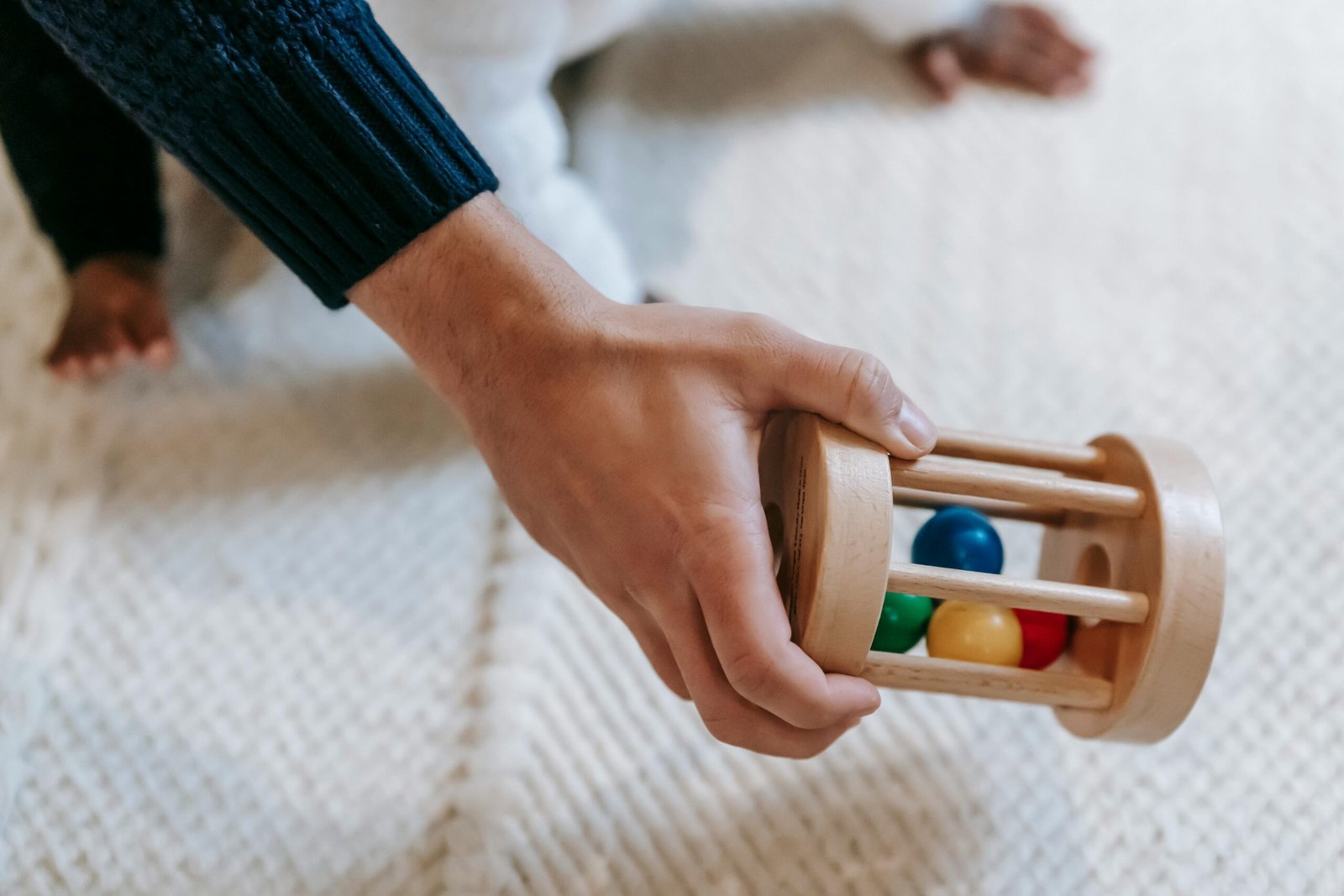
7.2 Why a rolling rattle is often recommended
A rolling rattle encourages tracking, reaching, and movement motivation.
Some people call this style a get up rattle because it nudges babies to move toward the toy.
Roll it a short distance, pause, and let your baby decide what to do.
If your baby ignores it, that’s still a valid outcome.
7.3 “Less is more” toy rotation for real life
Fewer toys often leads to better play because babies focus longer.
Toy rotation also helps when you’re buying 3 6 month toys or christmas gifts for three month old, because one high-use toy beats a pile of clutter.
A good baby rattle is a gift that gets used daily.
A trendy toy that looks impressive but doesn’t get picked up is just shelf decoration.
11. FAQ for Wooden Baby Rattle
Are wooden rattles safe for babies?
They can be safe when construction stays solid, edges stay smooth, parts don’t loosen, and you replace the toy as soon as wear shows up.
Why did Tiffany stop making baby rattles?
The question Why did Tiffany stop making baby rattles? comes up because even luxury baby items can be discontinued or pulled for safety reasons, so brand prestige never replaces basic safety checks.
What is the best wood for baby rattles?
Dense woods like beech, maple, and birch are common, but build quality and edge finishing matter more than the wood name.
Are wooden rattles better than soft rattles for newborns?
Wood is durable and simple, while soft rattles for newborns can feel gentler during accidental bumps, so many families rotate both.
What about rattle toys for infants in general?
The safest rattle toys for infants stay intact after drops and chewing, keep smooth edges, and avoid small detachable parts.
What toys are best for a 3–6 month old baby?
The best baby toys 3-6 months usually include a grip-friendly baby rattle, a safe teether toy, and a few calm sensory options.
Where do crinkle toys fit?
Crinkle toys add texture-and-sound exploration, but they don’t always replace the grip practice a solid rattle toy provides.
Learn more

As a mom of two, I learned when to stop burping a baby through trial and error. I’m sharing this clear, milestone-based guide so you can navigate this step with confidence.
Related Articles
You’re not alone on this parenting journey — every mom and dad learns step by step.Explore our baby essentials, parenting tips to help you raise baby with confidence and calm.
-
-

Baby Buddha 2.0 Reviews: A Working Mom’s Honest Take on Whether It’s Worth?
Here’s the thing—you’re juggling a million decisions as a new mom, and choosing a breast pump feels impossibly high-stakes. Will it actually empty you? Can you pump at work without…
-
Is Albeebaby Legit? My real Albee Baby Review
I’m a mom of two. When my oldest daughter was born, it was right in COVID-19 pandemic. so almost everything was bought through a babyonline store. I remember buying a…
-
Thanks God!! My daughter can finally sleep regularly.
My oldest daughter went through a challenging phase between 2.5 and 3 years old where she absolutely refused to sleep—sometimes staying awake until 3 AM! It took me quite a…
-