I’m a mom of two. And I’ll be real with you: with my first baby, I didn’t know half of what I know now.
On long trips, when she cried and cried and nothing worked, I did breastfeed in the car. More than once. Not because I thought it was some “good idea.” It was just… survival mode. Later, when my oldest could hold her own bottle, I also let her drink milk in her baby car seat plenty of times. It felt practical. It felt normal. And honestly, nothing dramatic happened—so I assumed it was fine.
Then I had my second baby, and I learned the hard way that “it seemed fine” isn’t the same as “it’s safe for this baby.”
One time, I breastfed her and then put her back in the car seat. About half an hour into the drive, she had this sudden, intense vomit. Not a little spit-up. The kind that makes you go quiet for a second because you’re shocked.
I told myself, okay… maybe that was a one-off.
But later, when she was a bit bigger and could hold a bottle, we had a rough drive. She was crying so hard. I was stressed. And I tried again—gave her the bottle while she was in the baby car seat. The ride itself was calm. No drama.
Then we parked. And she vomited again. A lot. Same “this is not normal spit-up” vibe.
That’s when it clicked for me: this isn’t one of those cute “mom hacks.” It’s one of those things you can get away with… until you can’t. And if your baby is refluxy or just sensitive, it can turn into a real problem fast.
So if you’re here searching can you feed baby in car seat, I’m not going to talk to you like you’re careless. I get it. You’re tired. You’re trying to get somewhere. Your baby is screaming. And you just want a plan that doesn’t feel impossible.
Let’s do this in a way that’s safe, realistic, and kind to your nervous system.
Quick answer: Can you feed baby in car seat?
If you’re asking can you feed baby in car seat while the vehicle is moving, the safest default is no.
If you need to feed, the safest version of “can you feed baby in car seat?” is: pull over somewhere safe, unbuckle, feed upright with supervision, then buckle back in.
(And yes, I know real life gets messy. The rest of this post is the “how do I actually do that on a long drive?” part.)
If you’re googling this, you’re probably already on edge
Most parents don’t look up can you feed baby in car seat on a chill afternoon.
If you’re reading this, chances are can you feed baby in car seat is coming from a real moment of stress—not curiosity.
They look it up when they’re already in the car, already late, already overstimulated, and their baby is doing that cry that makes your whole body tense.
So just… a quick reminder before we get into the “what to do” part:
You’re not a bad mom for wanting the crying to stop.
You’re not weak for feeling panicky in the car.
And you’re definitely not the only one who has tried something out of desperation.
What matters is having a safer default—so you’re not forced to improvise under pressure the next time can you feed baby in car seat becomes a panic search on your phone.
Can You Bottle Feed Baby in Car Seat?
If the car is moving, I’m going to say it plainly: don’t feed while the car is moving. If you’re asking can you feed baby in car seat while the vehicle is rolling, the safer answer is no.
Not because you need a lecture. Because feeding is one of those things that sounds simple until you add the car part. The angle. The bumps. The turns. The “I can’t quite see baby’s mouth.” The “what if they cough.” The “what if I have to stop the bottle right now.”
Authoritative guidance (with anchor text you can link out to)
According to public guidance from the CDC bottle-feeding guidance, safe bottle-feeding means an adult is actively holding and watching the baby (not bottle propping), keeping them in a semi-upright position, and responding immediately if they pause, cough, or need a break.
For solids and snacks, the CDC choking-hazards guidance says kids should sit upright and be closely supervised while eating—and it specifically recommends avoiding letting a child eat in the car or stroller, because choking can be harder to notice and respond to quickly.
Putting those two ideas together: if you’re asking whether you should feed during a moving drive, the safest practical approach is to pull over and feed in a stable, supervised setting (then buckle back in before you drive again).
Parked is better—but here’s the safest version
And yes, parents always ask the next question, which is totally fair: can you feed a baby milk in a car seat if the car is parked?
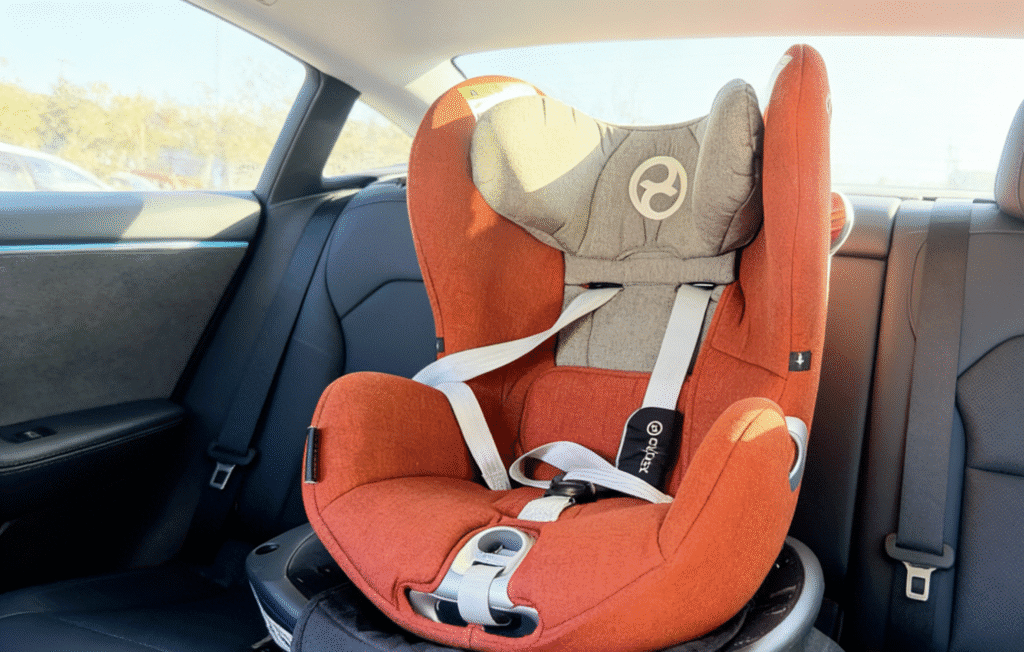
Being parked is definitely better than moving. But even then, the safest move—when you can—is still: park safely and take baby out of the car seat to feed. The car seat is made for crash protection, not as a feeding chair. And for some babies, the reclined car-seat angle after a feed is exactly where things go wrong.
That’s why I treat can you feed baby in car seat as a “stop and reset” question, even when you’re parked.
So when someone asks me can you feed baby in car seat while parked, my default answer is: If you can, unbuckle, feed upright, and keep it supervised.
The tricky part: “Nothing happened” can trick your brain
This is what got me with baby #1.
I fed in the car sometimes. She drank her bottle in the car seat sometimes. And nothing big happened.
So my brain filed it under: “Okay, this is a thing we can do.”
But the risk here isn’t like flipping a switch where it’s always fine or always not fine. It’s more like… a stack of conditions.
Baby’s age. Baby’s reflux situation. How fast the milk is flowing. Whether they’re half asleep. Whether the road is bumpy. Whether the adult is distracted.
So yeah—some families “get away with it.” Until they don’t. And when you’ve seen your baby suddenly vomit hard after a ride, it changes how casual you feel about the whole thing.
If you’re here because can you feed baby in car seat keeps coming up on long drives, you’re not imagining the pressure. This is exactly the kind of decision that feels “fine” right up until it isn’t.
Bottle propping in a car seat: I know why people do it. Still a no.
Let’s talk about bottle propping in car seat—wedging the bottle with a towel or blanket so baby can drink “hands-free.”
If you’re asking can you feed baby in car seat because you feel like you have to keep moving, this is usually the moment where the safest plan is a stop, not a workaround.
I understand the temptation. Truly. The baby wants to suck. You want to keep moving. You want to stop the crying. Your brain goes, “Maybe just for a minute…”
But the reason this gets called out so much is simple: if the bottle keeps flowing when baby needs a pause—because they cough, gulp too fast, or just can’t keep up—there’s no adult controlling it in real time.
So my honest take is: if you feel yourself reaching for propping, treat it like a warning light. It means you need a different plan. Not a better towel. For me, the moment you’re tempted to prop is the moment the “can you feed baby in car seat” question should turn into “where can we safely stop?”
“Can you put baby in car seat after feed?” This is the part reflux moms stress about
This question is so common. Because sometimes feeding isn’t the hardest part. It’s what happens after.
With my second baby, it was feed → car seat → time passes → then suddenly vomit. Twice.
If your baby doesn’t have reflux issues, you might not see anything dramatic. A lot of babies can handle being buckled in after feeding, especially if they’ve burped and seem comfortable.
But if your baby is refluxy—or you’re seeing patterns like “they seem okay during the drive and then throw up when we stop”—you probably need a buffer.
You’ll often hear people use around 20–30 minutes upright after feeding as a practical reference point when reflux is involved. Not as a promise. Not as a magic number. More like, “This is a common window that helps some babies settle.”
And “upright” doesn’t have to mean you standing there suffering. It can look like holding baby against your chest, calm, supported, with little burp breaks. Or building it into the stop: you feed, burp, then you do the diaper change and reset while baby stays upright.
If your baby has repeated projectile vomiting or anything that feels intense or unusual, please bring it up with your pediatrician. This isn’t about fear—it’s about getting tailored advice when your baby is clearly telling you something.
Can you feed purée and solids in a car seat: different topic, stricter boundary
People also search: can you feed baby puree in car seat and can you feed baby solids in car seat.
And I get it. Especially with toddlers. Snacks feel like the easiest way to get through a drive.
But solids are where the risk conversation gets more serious. If something goes wrong with a solid bite, you want to be in a situation where you can react immediately, safely, without the car moving.
So my simple, realistic rule is: purées and solids are “car fully stopped” activities. If you need to feed, stop first—even if it’s not your favorite answer. If you’re still asking can you feed baby in car seat with food, the safest tweak is: stop, supervise, and keep the child upright.
Real parents’ experience: almost everyone says “don’t feed baby in the car seat”
This gets asked over and over in parent communities. And when you read through the replies, the parent-to-parent consensus is surprisingly consistent:
- “If the car is moving: no. Pull over first.”
- “A car seat is a reclined crash-safety device, not a feeding chair.”
- “Feeding in the car seat often leads to bottle propping or not watching closely enough.”
Here’s a screenshot that shows the typical tone: one parent says “don’t feed while the car is moving—stop first,” and another explains the why (recline angle, choking risk, and how easily it turns into bottle propping or poor supervision).

If you just want one “do this” conclusion from real-parent experience, it’s:
Moving car: no.
Parked: better, but safest default = unbuckle + upright + supervised.
And if you catch yourself thinking, “Maybe I can make this work without stopping,” that’s often the moment can you feed baby in car seat becomes a bright red “we need a safer plan.”
The plan that helped me stop improvising: how I do long drives now
This is the part I wish someone had given me when I was a new mom. Not a lecture. A plan.
When we have a longer drive—say, a few hours—I don’t wait until things are melting down to figure out feeding. I try to set myself up so the “safe choice” doesn’t feel like the hard choice—because the hard choice is usually what pushes parents into the “can you feed baby in car seat” spiral.
If you’ve ever typed can you feed baby in car seat with one hand while holding back tears with the other, you know what I mean.
My road-trip packing mindset (not a giant checklist, just the essentials)
I pack like I’m preparing for two things: feeding quickly when we stop, and cleaning up calmly if baby spits up anyway.
So I bring enough to feed in a safe spot (bottles, whatever formula setup you use, or what you need for breastfeeding breaks), plus the boring-but-life-saving stuff: burp cloths, wipes, a spare outfit for baby, and—this is key—something for me too. A clean shirt.
If your baby uses formula, I’ve also found it helps to pre-plan the stop so you’re not fumbling: you can pre-measure powder, have water ready, and keep it simple. The whole point is to avoid that panicky moment where you think, “can you feed a bottle to baby in car seat” just because you don’t want to deal with the hassle of stopping.
My stop rhythm (how I pace it without overthinking)
I don’t try to follow a perfect timer. I follow the baby.
But I do pick a couple of predictable places along the route where stopping is easy—rest areas, gas stations with decent parking, a place where I won’t feel rushed. That way, when baby starts crying, I’m not debating whether to do something sketchy. I already know where I’m going to stop.
When we stop, I use one simple flow:
Stop → Feed → Burp → Upright → Back to seat
If reflux is a thing for your baby, that “upright” part matters more. For us, it really did.
And yes, sometimes the baby still spits up. Babies are babies. But the difference is: I’m not trapped in motion, trying to manage feeding and safety at the same time.
What if you truly can’t stop right away?
Sometimes you can’t pull over. Traffic. Bridges. No shoulder. It happens.
In that moment, the safest move is still: wait until you can stop safely.
I know that’s hard to hear when can you feed baby in car seat is running through your head and the crying feels unbearable.
And I know that sounds brutal when your baby is screaming. But shifting your goal helps. Instead of “feed now,” it becomes “soothe until we can stop.”
If there’s a passenger, they can sit close, talk softly, offer comfort, try a pacifier if baby takes one. If you’re alone driving, it might just be your voice. Singing, shushing, whatever works. It’s not perfect. It’s just the safest thing until you can stop.
If this keeps happening, it’s usually a planning signal—leave earlier, plan a stop before the “no stopping” stretch, or feed before you get on the freeway.
The family disagreement moment about feed baby in car seat
If someone tells you, “We did it and it was fine,” and you feel that tiny flash of guilt or anger… yeah. Same.
A line that keeps things calm is:
“I’m not judging what anyone used to do. I just want our baseline to be safer: we don’t feed while the car is moving. We’ll stop and do it properly, then we’ll keep going.”
It doesn’t attack anyone. It just sets a rule.
The honest takeaway about feed baby in car seat
So, can you feed baby in car seat?
If you’re still unsure, read that question again—can you feed baby in car seat—and remember the baseline is about visibility, control, and supervision.
If the car is moving: no.
If you can stop: stop, and feed in a more controlled position—ideally with baby out of the car seat.
And if reflux/GERD is part of your world: don’t ignore patterns.
I know it’s hard. I know it’s inconvenient. I know the crying can make you feel like you’re failing in real time.
But you don’t need to gamble on this. You need a repeatable plan that works when you’re tired:
Stop → Feed → Burp → Upright → Back to seat
And if reflux symptoms or repeated vomiting are showing up, please bring it to your pediatrician. You deserve baby-specific guidance, not just internet opinions.
About the Author
Hi, I’m a mom of two. This post is based on my real road-trip experiences with both of my kids—especially what changed for me after my second baby had repeated vomiting after feeds in the car. I’m sharing what I wish I’d known earlier, in a way that’s practical and non-judgy.
This article is for general informational purposes only and is not medical advice. If your baby has frequent vomiting, reflux/GERD symptoms, breathing changes, or feeding concerns, please check with your pediatrician.
FAQ
Can you feed baby in car seat while the car is moving?
Safer answer: no. If you’re asking can you feed baby in car seat in a moving vehicle, pull over and feed somewhere safe.
Can you bottle feed baby in car seat while the car is moving?
Safer answer: no. Pull over first.
Can you feed baby in car seat if the car is parked?
Parked is better than moving, but when you can, it’s still safer to take baby out to feed so you can control position and pacing.
Can you feed baby while in car seat if the car is parked?
Same idea as above: parked is better, but safer default is unbuckle + upright + supervised.
Can you feed a baby milk in a car seat if they can hold the bottle?
Even if they can hold it, the angle and the car environment can still make feeding harder to do safely. I treat “baby can hold it” as not a green light—I still prefer stopping to feed.
Can you feed a bottle to baby in car seat?
If you mean “can I just offer the bottle while they stay buckled,” the safer default is: stop the car, unbuckle, and feed upright with supervision.
Can you feed baby in car seat if there’s a passenger sitting right next to them?
A passenger can help soothe, but feeding is still safest when the car is fully stopped and you can supervise without motion.
Can you feed baby in car seat if you’re stuck in traffic?
If you can’t safely pull over, focus on soothing and stop at the first safe place to feed. If can you feed baby in car seat is the question, the first safe stop is the answer.
Can you feed baby in car seat if you’re driving alone?
If you’re the driver, it’s even harder to supervise feeding safely. The safer move is to wait until you can stop.
Can you feed baby in car seat if the bottle has a slow-flow nipple?
A slower flow can help some babies, but it doesn’t solve the bigger issue of feeding without full visibility and control in a moving environment.
Can you feed baby in car seat if your baby has reflux?
Reflux can make positioning and post-feed comfort more sensitive. Many parents find stopping and keeping baby upright after feeding helps more than feeding in the seat. If reflux is in the mix and you keep asking can you feed baby in car seat, that’s a strong sign to build in planned stops.
Can you feed baby in car seat for “just a minute” at a red light?
Even short moments can turn fast if baby coughs or the car moves again. Treat “can you feed baby in car seat for one minute?” as a cue to pull over somewhere safe.
What is bottle propping in a car seat—and why do people warn against it?
It’s wedging the bottle so baby drinks “hands-free.” It’s not recommended because the flow can’t be paused instantly if baby coughs, gags, or needs a break.
Can you feed baby puree in car seat?
If puree is needed, a safer default is: car fully stopped, and ideally feed in a more stable upright position than a reclined car seat.
Can you feed baby solids in car seat?
Safer default: no while driving. Solids/snacks are best saved for a full stop, when you can supervise and respond quickly.
Can you put baby in car seat after feed? How long should you wait?
It depends. Many babies are fine after a burp, but if reflux/GERD is in the mix, an upright buffer (often around 20–30 minutes) can help some babies settle. If vomiting is frequent or intense, check with your pediatrician.
If I keep searching “can you feed baby in car seat,” what’s the simplest rule to remember?
If the car is moving: don’t. If baby needs to eat, pull over somewhere safe, unbuckle, feed upright with supervision, then buckle back in.
Learn more

As a mom of two, I learned when to stop burping a baby through trial and error. I’m sharing this clear, milestone-based guide so you can navigate this step with confidence.
Related Articles
You’re not alone on this parenting journey — every mom and dad learns step by step.Explore our baby essentials, parenting tips to help you raise baby with confidence and calm.
-
-

Baby Buddha 2.0 Reviews: A Working Mom’s Honest Take on Whether It’s Worth?
Here’s the thing—you’re juggling a million decisions as a new mom, and choosing a breast pump feels impossibly high-stakes. Will it actually empty you? Can you pump at work without…
-
Is Albeebaby Legit? My real Albee Baby Review
I’m a mom of two. When my oldest daughter was born, it was right in COVID-19 pandemic. so almost everything was bought through a babyonline store. I remember buying a…
-
Thanks God!! My daughter can finally sleep regularly.
My oldest daughter went through a challenging phase between 2.5 and 3 years old where she absolutely refused to sleep—sometimes staying awake until 3 AM! It took me quite a…
-